Blogs / Core Web Vitals 2026: What Dubai Businesses Must Fix Before It’s Too Late?
Core Web Vitals 2026: What Dubai Businesses Must Fix Before It’s Too Late?
Core Web Vitals have become critical for SEO and user experience in Dubai’s competitive digital market. This blog explains the key performance issues businesses must fix—page speed, interactivity, and visual stability to improve search rankings, reduce bounce rates, and increase conversions before performance gaps start costing revenue.
January 20, 2026
In 2019, Google famously found that a mobile landing page took 15 seconds to properly load. However, the probability of bounce rate increased to 32% as load times went from 1 to 3 seconds. And, for each additional second, this rate increased by 90%.
While this statistic is almost 6 years old, it still holds, especially in hyper-competitive markets like Dubai. In such regions, a slow and unresponsive website is no longer a hindrance; it is a headache for the business.
As search engines like Google continue to refine their algorithms, a business website must meet performance benchmarks to be considered worthy of a place on the SERP.
Now, for Google, this threshold is determined by Core Web Vitals. So, the question in 2026 is no longer whether you should consider core web vitals or not. It is about how quickly you can fix it before it’s too late.
Your Guide To Core Web Vitals For 2026 & Beyond
The rising penetration and adoption of the internet and smartphones have changed the way businesses work across the world. Today, every business is present on the internet to reach out to its target audience.
Now, to better manage this “race for ranking,” Google introduced a set of performance benchmarks. Their job is to analyze each website based on key parameters and determine whether it offers an ideal user experience.
For any web development company, optimizing these benchmarks has become a core responsibility, as they directly influence usability, engagement, and search visibility. This set of performance guidelines is known as Core Web Vitals.
What Are Core Web Vitals?
Google defines Core Web Vitals as a set of standards, real-world performance signals that it uses to quantify user experience at scale. Unlike traditional page speed metrics that rely on synthetic tests, this paper uses field data from the Chrome User Experience Report.
Moving on, Google treats Core Web Vitals as page-level experience signals. It means each URL is individually analyzed instead of the website as a whole. This data is aggregated over a 28-day rolling window, which ensures consistency and not one-time optimization. So, technically, this acts as a ‘qualifying filter’.
Additionally, these signals are device-specific, with mobile performance carrying more weight due to Google’s mobile-first indexing policy. This means a page that performs well on desktop but performs poorly on mobile devices may fail Core Web Vitals in search results.
What Is A Good Core Web Vitals Score?
The good Core Web Vitals score for 2026 is -
LCP: ≤ 2.5 seconds
INP: ≤ 200 ms
CLS: ≤ 0.1
Pages outside this threshold are flagged as the ones requiring improvement.
Now, from an SEO standpoint, CWV is a part of Google’s broader Page Experience ranking system. It means that while they are not standalone ranking factors that can override relevance, they act as tiebreakers in competitive SERP, particularly in highly competitive markets like Dubai.
The Three Core Web Vitals
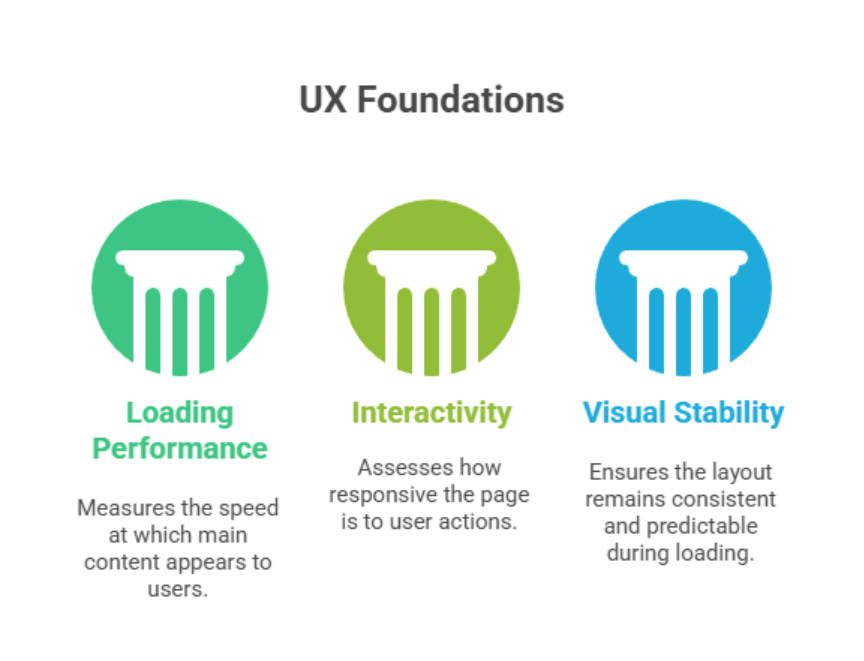
Largest Contentful Paint (LCP): It measures how quickly the main content of a page becomes visible, reflecting perceived loading speed for users.
Interaction to Next Paint (INP): It measures how responsive a page is to user interactions throughout its lifecycle, indicating overall interactivity and responsiveness.
Cumulative Layout Shift (CLS): It measures the visual stability of a webpage by tracking unexpected layout movements that can lower user experience.
Core Web Vitals vs Traditional SEO Metrics
Now, Let’s Explore The Differences Between CWV And Traditional SEO -
Aspect
Core Web Vitals (CWV)
Traditional SEO
What they measure
Real user experience signals like interactivity, loading speed and visual stability
Relevance and authority signals like keywords, backlinks and content quality
Data source
Real world user data gathered from Chrome users
Crawlers, indexing systems and third-party SEO tools
Focus
User experience
Authoritativeness of the page
Impact on rankings
Acts as a page experience signal and ranking differentiator in competitive SERPs
Core ranking factors that determine relevance and topical authority
Device sensitivity
Strongly focused on mobile-first indexing
Optimized primarily for desktop or content relevance
Optimization approach
Technical performance improvement
Content creation, keyword targeting, link building
Why Google prioritize it
Ensures search results lead to fast, usable and frustration-free experience
Ensures search results are relevant and trustworthy
Common Core Web Vitals Issues On Dubai Business Websites
CWV has emerged as one of the major ranking factors in modern-day SEO. However, many Dubai-based websites continue to struggle with recurring performance issues. Here are some of the highlighting ones -
(i)Slow Hosting And Poor Server Response Times
One of the biggest CWV issues that plagues business websites is slow hosting and poor server response time. Many businesses continue to rely on low-cost, shared hosting, where server resources are shared among multiple websites, leading to inconsistent performance during traffic surges.
Additionally, hosting non-optimized or overseas servers increases latency for users in the UAE. It means that, as the server takes too long to respond, the browser cannot render critical content, leading to delayed load times and a poor first impression.
(ii)Heavy Visual Content And Unoptimized Media
A trend of Dubai-based business websites is the use of high-quality visuals to reflect premium branding. Now, this comes at a cost: a slow, unresponsive website.
The large hero images, image sliders, and background visuals significantly increase page weight, leading to a drop in performance, even when core UI UX features are not optimized for speed and usability.
Additionally, features like auto-play videos further delay page rendering and consume valuable bandwidth, especially on mobile devices. Using outdated image formats like JPEG and PNG instead of modern formats like WebP or AVIF also slows loading times.
(iii)Third-Party Scripts And Tracking Overload
The modern websites rely heavily on third-party tools like live chat widgets, CRM integrations, heatmaps, and marketing automation scripts. While they are useful and improve the user experience, they often execute a large amount of JavaScript on the main thread, reducing the site’s ability to respond quickly to user interactions.
Additionally, when your site has excessive ad tags and analytics scripts, it considerably reduces the INP scores by blocking users during user input. The result is delaying clicks, sluggish scrolling, and a website that feels unresponsive; it is something that Google increasingly penalizes during rankings.
(iv)Poor Mobile UX And Layout Shifts
Another major issue with CWV is poor mobile user experience and an abrupt shift in website layout. Typically, unstable banners, dynamically injected elements, and promotional pop-ups mostly load after the main content, pushing other page elements around unexpectedly.
Not only this, but late-loading fonts and ads without predefined dimensions compound this issue. These layout shifts not only frustrate users but also lower credibility, particularly in industries like ecommerce, real estate, and finance.
Why Core Web Vitals Matter More In 2026 Than Ever?
In 2026, CWV matters more than ever as Google now evaluates websites based on how users experience the site in real time. It means that even if a website is well-optimized on paper but fails to engage and interact with the users, it will suffer.
As Google continues to rely on real-user field data collected over time, consistent performance has become a decisive ranking factor, especially in highly competitive markets like Dubai.
Now, The Business Risks Of Ignoring Core Web Vitals Are -
Reduced visibility in competitive search results.
Lower mobile rankings despite strong content.
Declining user trust and engagement.
Higher bounce rates and lower conversion rates.
Increased paid advertising costs due to poor landing page experience.
How To Run A Core Web Vitals Test?
Simply knowing the concept of CWV is not enough; you need to know how your site and pages are performing against this benchmark. For that, you need to run core web vitals test, and here is how you can do that -
Step 1: Test A Page Using Google PageSpeed Insights
You can start the process by testing one important page, like the home page or contact us page, using Google’s PageSpeed Insights. This tool presents a quick overview of how your page performs for real users on both mobile and desktop, along with a clear pass or fail status for Core Web Vitals.
Step 2: Review Core Web Vitals In Google Search Console
After that, you can open Google Search Console and navigate to the Core Web Vitals report. This shows how your entire website performs based on real-user data, grouping pages with similar issues together so you can easily see where problems exist.
Step 3: Understand Field Data vs Lab Data
Next, you need to distinguish between field data and lab data for a clearer picture of how your site is performing against the CWV benchmark. Here, the field data reflects real-world user experience that Google uses for ranking performance. The lab data, on the other hand, is simulated, which primarily helps in diagnosing issues.
Step 4: Identify the Root Cause
Once you know which pages are struggling, you need to review the diagnostics in PageSpeed Insights to understand the causes.
Step 5: Focus On High-Value Pages First
Now, once you have all the details, instead of working on all the issues at once, you have to prioritize. You need to focus on pages that matter most to your business. These include pages with high traffic, pages that generate leads or sales, and landing pages used for paid advertising.
Step 6: Implement Fixes and Re-test
After making improvements, run the tests again to confirm the changes worked. Use Google Search Console’s validation feature to notify Google of the fixes, keeping in mind that Core Web Vitals are evaluated over time and not instantly updated.
How To Improve Core Web Vitals?
Once you have run the CWV test and identified the issues, it's time to fix them. So, here is a detailed guide on how to improve core web vitals -
Step 1: Focus On The Loading Performance
The first step of your core web vitals strategyimprovement is to focus on bettering the loading performance. Here, you compress the existing images using modern formats like WebP and AVIF to reduce their sizes.
Next, you can use the fetchpriority="high" attribute on the LCP image and ensure it is discoverable in the initial HTML rather than hidden JavaScript.
Besides, you can focus on improving the content delivery network (CDN) to serve content from servers closer to users. And you need to upgrade the web hosting or implement server-side caching to reduce Time to First Byte.
Are CDNs Or Hosting Upgrades Essential For Sub-2.5s Loads In Dubai's Network Conditions? Yes, improving the content delivery network and hosting is important to achieve sub-2.5s loading times in Dubai’s network conditions. This improves user experience and boosts brand credibility.
Step 2: Increase Responsiveness
The next step is improving the website's responsiveness. Here, you need to focus on first breaking larger JavaScript tasks into smaller segments to allow the browsers to remain responsive even during heavy processing. For this job, you can use the scheduler.yield() API.
Next, you can audit the site using Chrome DevTools to eliminate any unused code and reduce main thread work. Also, you can debounce inputs and use AbortController for ftech requests to prevent numerous interactions from overwhelming the browser.
Step 3: Improve Visual Stability
The next point to focus on is improving the visual stability of the website. For that, you can start by defining the height and width of images, videos, and iframes to ensure they load within their allotted space. You also need to allocate space for advertisements to avoid disturbing the layout during loading.
Besides, preloading the critical fonts and preferring ‘transform’ and ‘opacity’ over ‘top’ or ‘left’ prevents any layout shifts and improves user experience.
Step 4: Ensuring Mobile Optimization
Alongside the previous three, you also need to work on the mobile optimization of the websites to improve their chances of scoring high on Core Web Vitals. As you are already aware of Google’s mobile-first indexing policy, your business website needs to comply with it to stand a chance of performing in a competitive market like Dubai.
To Ensure This, You Can Focus On -
Testing pages on real mobile devices.
Reducing mobile page weight.
Simplifying website layout and navigation.
Avoiding intrusive pop-ups.
Step 5: Monitor And Improve Performance
Lastly, CWV requires constant monitoring and improvements to maintain website performance over a long time. Here, you can take assistance with Google’s Search Console to get reports based on real user data and use PageSpeed Insights to get specific and actionable recommendations for individual pages—an essential practice for effective, performance-focused web design.
How Google Core Web Vitals Impact Business Revenue?
So, it is quite evident thatGoogle Core Web Vitals is playing a key role in improving business prospects over online channels. And, when you are operating in a digital-heavy market like Dubai, this becomes an indispensable part of marketing. Resultantly, it impacts business revenue, and here is how -
(i)Improves SERP Ranking And Organic Traffic
Since Google uses CWV as a ranking signal, businesses that score well on these parameters stand a chance to climb up the SERP ladder. As a result, they also see a surge in organic traffic, which boosts revenue.
(ii)Boost Conversion Rates
When websites are optimized according to CWV parameters, they deliver a greater user experience, which, in turn, translates to higher conversion rates. Hence, businesses see a rise in revenue.
(iii)Lowers Bounce Rate
When a website is optimized to deliver a superior user experience, it automatically reduces bounce rate. As a result, you see more positive customer actions, such as engagement or conversions.
(iv)Increases Brand Trust
When a website is fast, secure, and delivers a consistent experience, it helps in building brand trust. Users always prefer interacting with and shopping on platforms that provide a seamless experience, prompting them to come back again and again. This boosts the revenue potential of a brand significantly.
(v)Better Paid Ad Performance
Websites play a pivotal role in dictating the success of a paid ad campaign. When a website is well-optimized with all essential elements, it eventually improves key metrics such as cost-per-click (CPC) and click-through rate (CTR), directly supporting better performance across Google Ads campaigns.
Is It Too Late? What Dubai Businesses Should Do Now
From the discussion so far, it is obvious that Core Web Vitals are now a crucial part of digital marketing as they dictate the ranking of a website on Google. It means these metrics have moved from ‘good to have’ to ‘must have’, leading to increased focus on the matter.
Now, on to the real question – is 2026 too late for business to capitalize on this change? Well, in reality, the answer is no, but the window is closing fast.
Google now expects consistent, real-world performance, and Dubai’s competitive digital landscape leaves little room for slow or unstable websites. Therefore, the key is to act quickly, prioritize correctly, and put the right systems in place.
So, In The First 30 Days, Businesses Can Focus On Three Things To Set Up The Foundation, Which Are -
Run a Core Web Vitals test: The first step is always running an audit, which highlights the problem areas. Here, you can always use the help tools like Google PageSpeed Insights and Google Search Console. This helps you understand the issues and gives you a good starting point.
Fix critical errors first: Once the issues are identified, you need to move on to fixing the critical errors first. Here, the pages marked as ‘poor’ for LCP, INP, and CLS should be targeted first.
Prioritize Top Revenue Pages: While working on the critical errors, initially, you need to prioritize the top revenue-driving pages. The pages with high-quality traffic should be improved first to boost sales and lead generation.
Now, CWV optimization is not a one-time task. Google evaluates the performance over a 28-day rolling window, which means brands that are consistent see better results compared to others.
Ideally, you should implement monthly Core Web Vitals audits to track performance trends, identify new issues, and validate improvements.
How Long Does It Take For CWV Fixes To Show Up? Typically, it takes more than a month to reflect on the changes as Google evaluates websites once every 28 days owing to its 28-day rolling period policy. So, the changes will not be reflected immediately; you have to wait.
Work With Specialists For The Best Optimization Of Core Web Vitals
Optimizing CWV requires more than just basic SEO knowledge. It demands a combination of technical SEO, performance engineering, UX optimization, and local market understanding.
Hence, you need to find specialists to carry out this task. And, when it comes to a unique market like Dubai, local expertise proves even more crucial to make the necessary impact.
This is where we at Viacon Digital stand apart. With our proven expertise and extensive local market knowledge, we are perfectly positioned to deliver the results you are looking for.
Our performance SEO team is well-versed with Google’s ever-evolving algorithm, and their hands-on experience in the domain ensures your business website becomes a strategic advantage that propels your business to the summit of success.