Blogs / Mobile Marketing In Middle East: Best Practices For 2026
Mobile Marketing In Middle East: Best Practices For 2026
Mobile marketing in the Middle East is driven by a mobile-first audience, high smartphone penetration, and evolving user expectations. This blog highlights key best practices for 2026, including personalization, localized experiences, and data-driven mobile strategies that help brands increase engagement and conversions across the region.
January 24, 2026
With internet penetration and mobile phone adoption in the Middle East reaching saturation, smartphones have become deeply embedded in everyday lives. These devices are no longer connecting users to the information; they are shaping how people discover brands, engage with the content, and make purchase decisions.
For businesses, this has presented immense opportunities. They can now directly reach out to their audience, communicate in real time, and influence behaviour at every stage of the consumer journey through effective mobile marketing strategies that prioritize speed, personalization, and user-centric experiences.
However, success is not as straightforward, especially in a complex market like the Middle East. As mobile usage deepens, brands have to rethink their strategies, making them mobile-first to build a clear and strong connection with users, leading to a clear, sustainable advantage.
The Top 7 Best Practices For Mobile Marketing In The Middle East For 2026
In 2026, considering the current market situation, ignoring mobile marketing in the Middle East is a no-brainer. However, being random with it won’t drive results; instead, it will increase waste, making it essential to partner with a strategic marketing agency that understands the region, audience behavior, and performance-driven execution.
So, here are some best practices that you should be aware of to design an effective campaign -
(i)Focusing On Localization
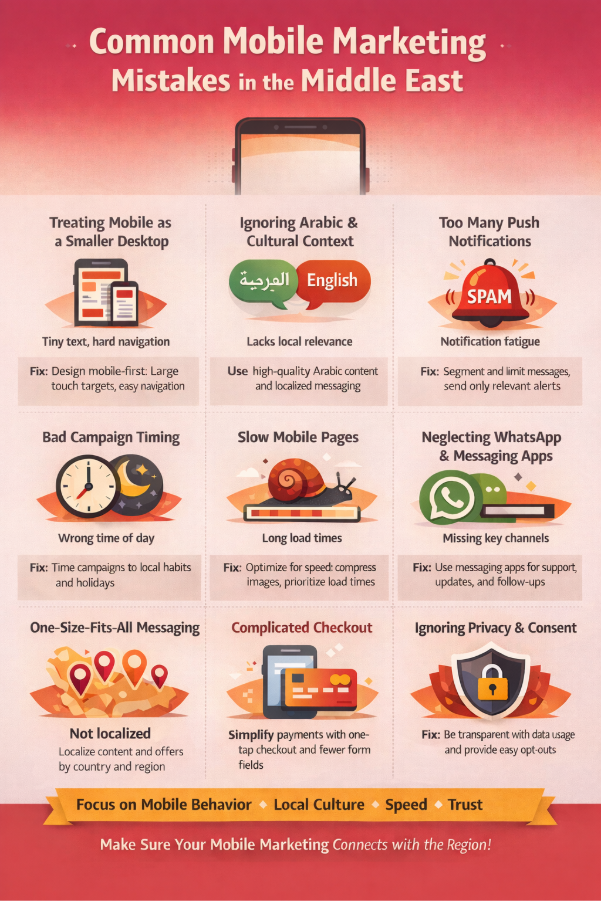
The Middle East is unique. The cultural, ethnic, and linguistic diversity it offers makes this market challenging for marketers. So, while drafting mobile phone marketing plans, brands need to make an effort to increasingly localize their effort.
So, while designing the campaign, you need to ensure that the content is created in both English and Arabic, along with the language of the specific demographic that you are targeting. Also, the campaign must align with local sensibilities and reflect the cultural nuances.
(ii)Prioritizing Personalization
When designing a marketing campaign for a diverse market like the Middle East, you need to focus not only on localization but also on personalization. Since the target demography is vast, a generic message will fail to make the desired impact.
To truly connect, brands must tailor communication for each audience segment, an approach that is especially critical for luxury brand marketing in Dubai, where customer expectations around exclusivity, relevance, and experience are exceptionally high.
Here, you can take the help of artificial intelligence and curate messages and strategies that will better align with consumer expectations. As a result, you will notice better engagement and subsequently conversion, leading to the success of the campaign.
(iii)Creating Individual Channel-based Strategy
The next best practice to focus on is creating individual channel-based strategies. It means you have curated plans for platforms like Meta, Google, and any other local platforms that you are targeting.
The reason behind this approach is simple: if you go for a one-size-fits-all plan, then you are unlikely to receive any results. Instead, a plan tailor-made for a particular platform accounts for its strengths and weaknesses and the user base, which, as a result, leads to better performance.
(iv)Investing WhatsApp Marketing
In mobile phone-focused marketing efforts for the Middle East, WhatsApp deserves special attention. In this region, this platform is more than a messaging app; it is a customer experience channel. From finding products, viewing them, placing an order, and receiving support, WhatsApp can handle the entire customer journey.
Therefore, when integrated properly, WhatsApp becomes a bridge between marketing, sales, and service.
What Are The Most Popular Mobile Ad Formats In Saudi Arabia And The UAE? Short-form vertical video is the most popular ad format in Saudi Arabia and the UAE in 2026. This format is drawing the biggest engagement numbers, outperforming others. In some cases, digital banner ads have proved effective as well.
(v)Following The Latest Trends
It goes without saying that when designing marketing campaigns for the UAE, you must factor in the region’s mobile user behaviour trends, as these insights shape how audiences discover, engage with, and convert through mobile-first experiences, making them a critical part of broader digital marketing trends in the region.
Why? Well, if you are not aware of what’s happening across the Middle East and how consumers are reacting, then creating a successful campaign becomes a tough ask.
It Leads -
Irrelevant campaigns
Poor performance
Wastage of crucial company resources
(vi)A/B Testing Every Campaign Idea Before Launching
Lastly, a mobile marketing best practice every brand must follow is to A/B test each campaign before launching. Once the campaign idea is final and the content and creatives are ready, it is important for marketers to publish it on a smaller scale to see how the audience is reacting.
If the reception is positive, they can go ahead; otherwise, they need to rethink and make the necessary changes.
Additionally, simply stopping at A/B testing is not enough; brands need to keep monitoring the campaign performance and make changes time-to-time to optimize it for the best outcome.
(vii)Maintaining Transparency And Complying With Local Privacy Laws
Often overlooked, but one of the most important mobile advertising trends that brands miss out on is maintaining transparency and complying with local privacy laws. As mobile interactions increase, so do concerns around data usage, making transparency a trust-building factor.
For brands investing in local digital marketing, clearly communicating how user data is collected and used can provide a strong competitive advantage in privacy-conscious markets.
The Best Practices Include:
Clear consent mechanisms
Simple opt-out options
Visible compliance with UAE regulations
Besides, complying with local privacy laws also ensures the brand does not face any Governmental action that ultimately damages its reputation.
How Do UAE And Saudi Data Protection Laws Affect Mobile Tracking? The UAE and Saudi data protection laws significantly affect mobile tracking and limit the scope of mobile marketing. Today, brands have to gain consent from consumers to use their data and follow all governmental laws to ensure their campaign remains within the bounds of the law and does not incur any fines.
How To Measure Mobile Marketing Performance?
Simply designing a mobile marketing strategy is not enough. You need to keep measuring its performance to ensure everything is on track. For that, you need to track the following -
(i)Mobile Traffic
Measuring mobile traffic and reach is an excellent way to determine the effectiveness of the mobile marketing strategy. If your brand is receiving consistent traffic from mobile devices, it indicates the success of your campaign and vice versa.
(ii)Engagement Rate
The engagement rate is another key factor that determines the success of a campaign. When users consistently interact with the content, and there’s a noticeable increase in average session duration, scroll depth, and in-app actions, it indicates the content is relevant, effective, and successfully strengthening the brand’s overall online presence.
(iii)Click-through Rate (CTR)
The CTR is another key benchmark to judge the performance of mobile marketing. When more and more people click on ads or open push notifications, it means the messaging has been effective.
(iv) Mobile Checkout And Funnel Drop-offs
Mobile checkout and drop-offs are excellent indicators of the effectiveness of a smartphone marketing campaign. If you see that the cart abandonment rates are low, payment failures are decreasing, and users are completing their buying journey, then be assured that the campaign has struck a chord with the audience.
What Mobile Payment Methods Are Mandatory For Middle East eCommerce? The mobile payment methods that are mandatory in the Middle East are MADA, Apple Pay, Careem Pay, and STC Pay to offer a seamless buying experience and improve conversion rates.
(v)Overall Conversion Rate
The overall conversion rate, which comprises purchases, form submissions, bookings, app sign-ups, etc., reflects the marketing campaign’s performance. They stand for the revenue the campaign has generated and the overall ROI it is delivering.
(vi)Retention And Repeat Purchase
To judge the effectiveness of a marketing campaign, you also need to track user retention and repeat purchases. This involves measuring how often users return after the initial interaction and whether they reorder.
Retention is a key indicator of long-term success and plays a critical role in digital marketing strategy creation, helping brands optimize campaigns for sustained growth rather than short-term wins.
Types Of Mobile Marketing Brands Should Use
As the effectiveness of mobile phone marketing is well-established, now it is important to understand the options at disposal that can make it happen. Here are the types of mobile marketing that brands can use -
SMS marketing: Direct text messages for promotions, alerts, and updates.
Push notifications: App-based alerts delivering timely updates and keeping brands at the top of the mind.
Location-based mobile marketing: Also known as geo-targeting, it delivers relevant ads and offers when users are in a particular location.
In-app marketing: Advertising on other apps helps reach a larger user base across the Middle East.
QR-code Marketing: Scannable codes presented on the web and app links to specific pages or offers.
Crack The Mobile Marketing Code With Viacon Digital
To sum up, mobile marketing is the new reality of the Middle East market. Today, brands cannot ignore their importance and must adhere to the best practices to make the most of the opportunities that it presents.
This marketing practice allows them to make a more curated pitch to the users that resonates well and delivers tangible outcomes. However, to realize that they need two things: experience and local market knowledge.
But, for brands, building this expertise in-house is not always practical, and this is where they need the right partner. With proven experience and strong regional insights, Viacon Digital allows brands to navigate the complexities of smartphone marketing in the Middle East, turning strategy into execution and execution into growth.