Blogs / Facebook vs Instagram Ads In Dubai: Which Drives Better ROI?
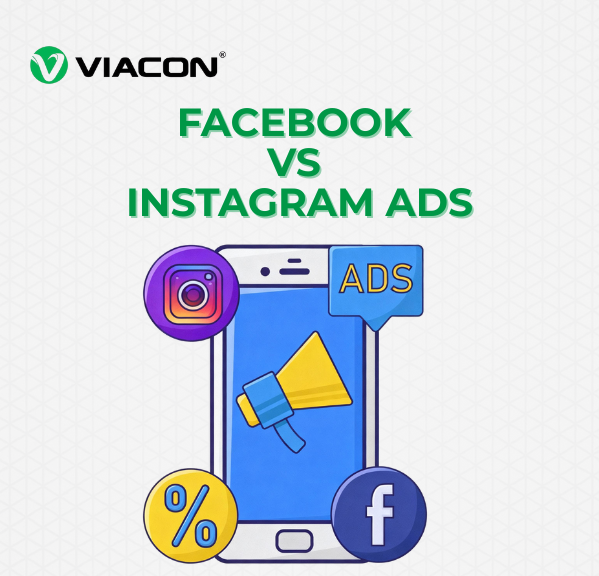
Facebook vs Instagram Ads In Dubai: Which Drives Better ROI?
Paid ads are unlocking a new dimension of Instagram and Facebook marketing. So, here is a comparative analysis of them to help you make the best decision...
November 11, 2025
Social media marketing is not what it was, let’s say 5 years ago; it has transformed significantly. The reasons behind this evolution can be traced back to the emergence of new technologies and evolving consumer behaviors.
Now, when you put it in the context of a competitive market like Dubai, which has a nearly universal social media penetration, brands are left with a complex question – which platforms deliver the better ROI: Facebook or Instagram?
While both platforms are under the umbrella of Meta, they are very different. While Facebook marketing focuses on reach and conversion, Instagram is ideal for brand awareness and visual storytelling.
Keeping up with the latest social media trends helps brands understand how audiences engage differently on each platform and adapt their strategies to maximize impact and performance.
Understanding Meta Ads: Facebook And Instagram
Meta Ads comprises both Facebook and Instagram advertisements, which are managed through Meta Ads Manager. This unified platform gives you a chance to create, manage, and optimize ads and ensure better ROI. So, let’s uncover each platform one by one for better understanding.
(i) Facebook Advertisement
As the name suggests, Facebook ad refers to the paid advertising services provided by Facebook. Now, these ads are designed to help companies promote their products and services within Facebook’s ecosystem.
Now, the ads typically appear on a user’s sidebar, feed, on the Marketplace, and also on Facebook’s partner networks. Thus, you can now target an audience with more precision.
Declining organic reach for business pages, making paid ads more essential.
Variety of ad formats and placements (feed, stories, etc.).
Ad fatigue and user oversaturation reduce effectiveness.
Relatively accessible for small budgets / flexible spending.
Conversion rates can be lower compared to intent-driven platforms; requires continuous optimization.
Strong retargeting capability based on user behavior.
Platform policy changes (e.g., privacy updates) can impact targeting precision.
(ii)Instagram Advertisement
Being another social media platform under the umbrella of Meta, Instagram is vastly different from Facebook. Unlike the latter, Instagram is a visual-first platform, which means photos and videos are the primary modes of content.
Inspired by the rise of TikTok trends, Instagram has also evolved to prioritize short-form video content like Reels, making it essential for brands to adapt their strategies to stay relevant and engaging.
Therefore, the ads you run here must be visually compelling to stand out. Typically, the Instagram ads appear on feed, stories, explore pages, and reels.
Pros And Cons Of Ads On Instagram
Pros Of Running Ads On Instagram
Cons Of Running Ads On Instagram
High engagement rates and strong visual storytelling appeal.
Requires high-quality visuals and creativity to stand out.
Popular with younger, mobile-first demographics (Millennials/Gen Z).
Higher cost per click (CPC) and higher competition in certain industries.
Seamless integration with Facebook’s ad platform (for targeting, analytics).
Limited clickable links in organic posts (less direct traffic compared to some platforms).
Strong for e-commerce, lifestyle, and brand-building contexts.
It can be less effective if your target audience skews older or if your business is text-heavy rather than visual.
The Key Difference Between Facebook Advertising And Instagram Advertising
While exploring Facebook and Instagram advertising, it is important to recognize their differences.
Why? Well, it will help you to choose the right audience for your ads on Facebook or Instagram and get the desired results. So, here are the key points of difference that you should know -
Difference 1: Audience Demography
The first point of difference between these two platforms is the audience demography. Facebook has an older and more mature demographic where the average age of users primarily ranges between 25 and 54.
As a result, this platform becomes handy while designing campaigns for professionals, families, and older consumers. Additionally, this wide demographic range also allows businesses to create and run diverse campaigns for both B2B and B2C brands.
When combined with effective Instagram marketing, businesses can reach younger audiences through visually engaging content while maintaining strong connections with mature demographics across Facebook.
Instagram, on the other hand, is a more youthful platform. The average age of users on this platform falls in the bracket of 18 to 34, which makes it more popular among the youth of the city.
Therefore, it has become the go-to platform for brands targeting Gen Z and millennials, who are more visually driven and responsive to lifestyle-oriented content. This makes Instagram ideal for fashion, beauty, travel, and entertainment brands.
Difference 2: Style Of Content
Considering the age group of the target audience, Instagram and Facebook also have prominent differences in terms of content style.
For ads on Facebook, you can use a variety of content formats, including text-heavy posts, videos, links, carousels, and lead generation forms. Now, this flexibility enables brands to explore the depths of different topics.
Conversely, on Instagram, the crowd is youthful, and so is their content preference. They prefer high-quality visuals that quickly grab your attention.
This platform mostly focuses on minimalism and aesthetics, with very limited space for text. Hence, the ads here are best suited for showcasing products, establishing brand identity, and invoking aspirations.
Difference 3: Engagement Numbers
The next point of difference is the engagement numbers that these two platforms register. Traditionally, Facebook records lower engagement numbers, but it compensates with higher reach and more user interactions.
Instagram, on the other hand, boasts some of the highest engagement numbers among social media platforms. This is particularly due to the visually rich content published on this platform. Users are more likely to share the content they like through, which helps when you run a brand awareness or community-building campaign.
Difference 4: Placement Of Ads
The next point for the difference between Instagram and Facebook advertising is how the ads are placed on these two platforms. Usually, the ads on Facebook appear in different locations like News Feed, Marketplace, Messenger, and even the right-hand column on desktop. This variety allows advertisers to tailor placements based on campaign goals and user behavior.
Incorporating these ad placement insights into your overall social media strategy helps ensure your content appears where your audience is most active and likely to engage.
However, on Instagram, the ads appear on Feed, Stories, Explore Tab, and Reels. Now, a key factor to understand is that this is designed for mobile-first consumption, offering an immersive experience that blends seamlessly with organic content.
Difference 5: Integration Of Social Commerce
The next point of difference is the integration of social commerce. While Facebook offers shopping features and allows you to run ads based on them, the experience is not entirely seamless.
Partnering with a social media marketing agency in Dubai can help businesses optimize their ad strategy, enhance the shopping experience, and create more cohesive campaigns that drive conversions across both Facebook and Instagram.
Alternatively, on Instagram, this experience is seamless. It offers multiple features that further enrich the user experience, making it easier to convert from the shopping ads.
Here Is A Look At The Differences between Facebook And Instagram Ads At A Glance -
Aspect
Facebook Ads
Instagram Ads
Audience demographic
Broader age range, including older users (30+)
Facebook is better suited for lead generation, retargeting, and conversion focused campaigns
Style of content
Text-heavy posts, links, and diverse ad formats
Visual-first: images, videos, Stories, Reels
Engagement potential
Lower engagement rates but higher reach
Higher engagement rates, especially for visual brands
Placement of ads
News Feed, Marketplace, Right Column, Messenger
Feed, Stories, Explore, Reels
Use case
B2B, lead generation, detailed messaging
B2C, brand awareness, lifestyle and product promotion
Integration of social commerce
Facebook Shops, but less seamless than Instagram
Native shopping features like product tags and Instagram Shop offering a seamless experience
Estimated Cost
• Average CPC: AED 8.80 (~$2.40) • Average CPM: AED 10–50 ($2.70–13.60) • Cost Per Lead (CPL): AED 25–55 ($7–15)
• Average CPC: AED 1.50–3.50 ($0.41–0.95) • Average CPM: AED 20–40 ($5.45–10.90) • Cost Per Engagement (CPE): AED 0.04–0.20
ROI Insights
Facebook is better suited for lead generation, retargeting, and conversion-focused campaigns
Instagram excels in brand awareness, visual storytelling and driving engagement
How To Choose Between Facebook And Instagram Ads?
Now comes the ultimate conundrum: which platform to choose for running ads? While both of them have their pros and cons, you need to make the ultimate decision to ensure it fulfils your goals. To help your decision-making, here are some pointers that you can keep in mind -
Target Audience: Depending on your target audience, you need to choose the platform. If you are leaning more towards the B2B side of things, then Facebook advertisementis the ideal way to go, considering its older demographic.
Content Strategy: Now, if you have an FMCG brand and have decided on a more youthful content plan for a particular product, then you should think of Instagram to run the ads. The crowd there is young, and the content will easily resonate with them.
Budget: Lastly, you need to evaluate your budget to decide on the best ad format. While the CPC of Facebook ads is high, its CPM is comparatively lower than Instagram's, and vice versa.
How To Create Meta Ads For The Dubai Market?
While Facebook and Instagram are contrasting as platforms, just knowing how to create a Facebook ad in 2025 is not ideal. Instead, you should know how to set up Meta Ads. So, to help your cause, here is a step-by-step guide -
Step 1: Head Over To Facebook Ads Manager
To commence this process, first, you need to visit Facebook Ads Manager and log in with your business account. This is your control room for all Meta campaigns.
Step 2: Define The Campaign Objectives
Once you’re inside Ads Manager, click on “Create” to start a new campaign. Meta will prompt you to choose an objective aligned with your marketing goals.
Some common objectives include:
Awareness
Traffic
Engagement
Leads
Sales or Conversions
Step 3: Identify The Target Audience
This is one of the critical parts of Facebook marketingto find success in a diverse and competitive market like Dubai. Here, you can use Meta’s advanced audience filters to find the target users based on location, demographic, language, and behavioral traits.
Step 4: Set your budget
The next step is setting up the budget. Here, Meta allows you to choose your daily or lifetime budget. The daily budget, as the term indicates, sets the amount you can spend on a single day, and similarly, for the lifetime budget, you set the total budget of the campaign.
Step 5: Choose The Ad Placement
Once you have selected the budget, your next job is to choose where you want to place the ad. In this regard, you have two options -
Automatic Placements: Here, Meta optimizes ad delivery across Facebook, Instagram, Messenger, and Audience Network.
Manual Placements: Here, you decide exactly where your ad appears.
Step 6: Design The Ad Creative
Once you have decided on the ad placement, your next job is to design the ad creative. In Dubai’s visually driven digital environment, make sure your visuals and text align with the luxury and innovation standards the market expects.
Step 7: Review And Publish The Campaign
Once you have set up everything, it's time to review the campaign. You go through all the finer details and then publish it.
Step 8: Monitor, Analyze, And Optimize
The next step is to monitor your campaign's performance, analyze the metrics, and optimize it accordingly to achieve the best ROI.
Meta Ads Checklist: Your go-to Document For Running Ads On These Platforms
Before you hit publish, here is a comprehensive checklist to ensure your Meta Ads campaign is optimized for the Dubai market -
Clearly defined campaign objective (e.g., awareness, traffic, conversions).
Target audience tailored to Dubai’s demographics and interests.
Bilingual ad copy (English & Arabic) for broader reach.
High-quality, culturally relevant visuals or videos.
Platform-appropriate formats (e.g., Reels for Instagram, Carousel for Facebook).
Facebook Pixel is properly installed for tracking and retargeting.
Mobile-optimized creatives for better performance on smartphones.
Budget and schedule aligned with peak engagement times in the UAE.
Compliance with UAE advertising laws and Meta’s ad policies
Choosing between Instagram and Facebook advertisingis tricky. With both platforms offering multiple benefits, the decision ultimately comes down to your preference, most importantly, what your brand needs.
Depending on the campaign objectives and budget, you need to analyze and select a platform that presents the best chance to fulfill them.
However, one point that often gets downplayed here is the experience. One needs to have the necessary experience to know which platform will yield the best results, and this is where Viacon comes in.
With our team of social media experts, we curate the best strategy and choose the ideal platform to deliver the results and the ROI you are looking for.
Frequently Asked Questions:
Q1. Is It Possible To Run The Same Ad On Facebook And Instagram?
A: Yes, it is possible to run the same ad across Facebook and Instagram using the Meta Ads Manager. The platform lets you create a single campaign and then publish it to both platforms. Now, you can either choose to run them automatically or do it manually based on your preferences.
Q2. What Is The Reason Behind Meta Ads Getting Rejected In The UAE?
A: The primary reason your Meta Ads are being rejected is a combination of Meta’s global advertising rules and specific regulations in the UAE. Therefore, you need to look into these aspects and find out what is going wrong.
Q3. How To Improve The ROI Of Meta Ads In Dubai?
A: To improve the ROI of your Meta Ads in Dubai, you need to work on refining the target audience, optimizing the ad creative and copy, implementing strong conversion tracking, and managing the budget judiciously. Besides, continuously monitoring and analyzing ad performance and using AI tools for better targeting can also help.
Q4. Do I Need A Business License To Run Meta Ads In Dubai?
A: Yes, you need a valid business license to run Meta Ads in Dubai. Otherwise, it can lead to fines or ad suspensions.
Q5. Which Is The Better Ad Format For Ecommerce In Dubai: Facebook Or Instagram?
A: It is impossible to identify one platform and say this is the ideal one for running ecommerce ads. Both platforms have their USPs, and they help brands differently. So, based on your business objectives, goals, target audience, and the product you sell, you need to make a decision.