Blogs / AI Chatbots: Why Modern Companies Are Making Them A Core CX Investment?
AI Chatbots: Why Modern Companies Are Making Them A Core CX Investment?
AI chatbots are transforming how brands are now marketing their offerings. With personalized aid and suggestions, they are improving customer experience and driving revenue...
December 22, 2025
The introduction of artificial intelligence has opened new avenues for business optimization. Besides streamlining the operations, it has also improved customer experience through personalized messaging and uninterrupted support. A key player in this transformation is the AI-backed chatbots.
The traditional chatbots were introduced to offer round-the-clock support; the integration of AI simply made them smarter. Today, advanced systems can understand and interpret user queries, provide accurate answers, and reduce the need for human intervention.
AI Chatbots For CX: Quick Summary AI chatbots have evolved into strategic CX assets that help businesses deliver personalized support, reduce operational costs, and scale customer interactions efficiently. When deployed with the right data architecture, governance, and human oversight, they deliver measurable ROI while improving customer satisfaction and retention.
Why Are Modern Companies Investing In AI Chatbots?
The shift from traditional, rule-based chatbots to advanced AI chatbots is not just a technological upgrade. It represents a shift in business strategy, where companies are no longer looking for automation; they are now seeking intelligent and adaptive solutions that offer measurable results across digital touchpoints, including customer support, lead nurturing, and social media advertising.
So, here are some major reasons why brands are now increasing their investments in AI-powered chatbots -
(i) Improves Customer Experience Through Personalization
The biggest reason behind investing in modern chatbots is how they considerably improve customer experience through personalization.
Unlike the rule-based chatbots that can only reply to a few pre-set queries, the AI-backed ones now use machine learning to analyze past conversations, purchase history, and user preferences, which leads to more personalized responses.
Now, this curated approach enables a more human-like interaction that subsequently builds trust and elevates customer experience.
(ii) Lead Generation And Sales Automation
The next reason justifying this investment is the lead generation and sales automation capabilities of AI chatbots. The modern chat agents act as proactive sales agents as they engage with visitors, ask qualifying questions, and collect contact information.
At times, these chatbots also guide users through the entire purchase journey, further boosting conversion rates.
What Is The ROI Of Investing In AI Chatbots For Customer Service? The ROI of investing in AI chatbots for customer service is excellent. It addresses the basic questions and resolves initial queries, leaving the more complex ones for human executives. This successfully reduces the cost of hiring multiple people for a more straightforward job. In most organizations, measurable ROI appears within six to twelve months through reduced support costs, faster resolution times, improved first-contact resolution, and increased lead conversions.
(iii)Collects Valuable Business Data
Every interaction with AI-backed chatbots generates data on customer pain points, interests, behavior patterns, and more. When the sales and marketing team analyzes this information, it provides valuable insights into product development and marketing strategies, ultimately improving overall business decision-making.
(iv)Improves Operational Efficiency
A major reason for justifying this investment is how they enhance operational efficiency. The AI-powered chat agents can handle multiple conversations simultaneously without performance degradation. It means even during the peak hours, your customers get all the answers they need.
Now, this enables businesses to seamlessly manage a sudden spike in demand and expand into new segments and geographical regions without any hassle.
(v)Reduces Operational Cost
With the help of AI chatbots, companies can now significantly reduce the operational costs associated with customer service and support teams. These chatbots easily handle repetitive queries or basic issues, enabling companies to grow their businesses without increasing their support teams.
Additionally, it also keeps the human support team available for more complex issues that require human judgment.
When AI Chatbots Are Not The Right CX Solution
While AI chatbots offer immense value, they are not a universal replacement for human-led customer interactions. Emotionally sensitive conversations, legal disputes, medical decisions, or high-risk financial discussions require empathy and contextual judgment that AI cannot consistently provide.
Which is why AI in digital marketing is most effective when applied as a support layer rather than a complete replacement for human expertise.
Additionally, organizations with fragmented data systems or poorly defined CX workflows may experience inaccurate responses or poor customer satisfaction. In such cases, foundational CX processes must be addressed before scaling AI-driven automation.
GenAI vs Traditional Chatbots: What Companies Should Know Before Investing?
Aspect
Gen AI Chatbots
Traditional Chatbots
Definition
Use advanced generative AI models to understand, generate, and adapt to natural language responses
Uses predetermined rules and decision trees to respond. And limited ability to generate curated responses
Core technology
Large Language Models, deep learning and neural networks
Rule-based logic, decision trees and pattern matching
Conversational flexibility
High as it can handle open-ended and varied conversations
Low as it is constrained to scripted flows.
Contextual understanding
Strong as it can maintain context even during longer conversations
Weak as it loses context outside of defined patterns
Response generation
Generates human-like, creative responses
Returns pre-written, static responses
Training data
Trained on broad datasets and continues to learn from previous interactions and updates
Limited to developer defined answers
Adaptability
Highly accurate and reliable, but hallucinate at times if not properly configured
Requires manual updates to the answers and scripts
Use case
Customer support, knowledge assistance and complex queries
Guided menus, simple customer service questions
Complexity of implementation
Higher as it requires extensive infrastructure
Lower as it is easier to deploy and maintain
Cost of adopting
Higher initial as well as scaling costs
Comparatively lower upfront cost and predictable maintenance budget
Accuracy and reliability
Highly accurate and reliable, but hallucinates at times if not properly configured
Predictable and reliable in a known scope of operations
Scalability
High
Moderate
Maintenance
Requires ongoing maintenance
Needs periodic manual script updates
Best for
Companies looking for advanced chatbot AI support
Businesses with narrow and predictable chatbot needs
Industry-Specific Use Cases: How AI Chatbots Transform CX Across Sectors
The modern chatbots powered by generative engines are reshaping customer experience across industries. Here is more on industry-specific use cases of AI-backed chatbots -
Industry Use Case #1: Ecommerce
In the online retail industry, AI chat assistants act as intelligent shopping assistants, improving the buying journey. It analyzes buyer preference, browsing history, and natural language queries to recommend products, compare features, and answer detailed questions.
Additionally, the GenAI chatbots proactively re-engage shoppers who left abandoned carts through periodic reminders, personalized discounts, and addressing the issues. A conversational approach here improves conversion rates.
Industry Use Case #2: BFSI(Banking, Financial Services & Insurance)
The AI chatbots have been a revolution for this industry. Today, they are guiding users through different journeys like performing eligibility checks, collecting financial details, sending loan repayment reminders, etc. This practice is reducing friction and operational costs.
Besides that, the AI chat agents are also helping detect fraud by using real-time data. They are notifying customers of any suspicious activities and verifying transactions.
Escalating issues to improve security and customer confidence is an approach increasingly adopted by digital marketing agencies in Dubai to build trust-driven, data-secure customer experiences for financial brands.
Industry Use Case #3: Healthcare
The healthcare industry is also seeing an influx of AI chatbot integration to improve access and efficiency without compromising care. Today, chatbots are assessing symptoms using structured medical logic, prioritizing urgencies, and guiding patients to the appropriate treatment path.
Additionally, when integrated with hospital systems, the chatbot AI is helping with scheduling and rescheduling appointments and sending reminders to offer a more seamless user experience.
Industry Use Case #4: Hospitality
The AI-powered chat agents are also transforming customer experience in the hospitality industry. The Gen AI chatbots, similar to Google AI chatbots, are now providing 24/7 recommendations for food, places to explore, activities to participate in, etc. These chatbots are now adapting to guest preferences and are capable of handling multilingual interactions, thus enriching the customer experience.
Industry Use Case #5: Real Estate
You may wonder how AI chatbots are helping the real estate sector. Well, you will be surprised at how important they have been in the growth of this sector. As you are well aware, real estate decisions are complex and high-value, and the AI chat agents are simplifying these decisions.
Based on the buyer's interaction and understanding of their preferences and budget, they are now recommending properties. This significantly improves conversion rates while reducing the workload on human real estate agents.
Industry Use Case #6: EdTech
The inclusion of Gen AI chatbots is now helping personalize the learning experience. These chatbots are answering student queries, explaining concepts, providing reminders of deadlines, and providing personalized resources.
Additionally, when integrated with analytics, these chatbots can adapt their responses to student progress, further elevating learning outcomes.
How Do AI Chatbots Improve Customer Satisfaction And Reduce Churn? The AI chatbots improve customer satisfaction and reduce churn by providing instant and personalized responses to customers. For instance, a user wants to know how he/she can get a refund for paying twice. The chatbot should guide the individual through the refund claim process. It will solve the query, improve customer satisfaction, and reduce churn effectively.
Key CX Metrics To Track When Deploying AI Chatbots
Developing a curated AI chatbot for your business requires a hefty investment – monetary and time-wise. Therefore, you need to ensure that it is worth the investment and brings the desired outcomes that contribute to business growth.
For that, you need to track the following CX metrics to understand how customers are interacting with the chatbots -
Customer Satisfaction Score (CSAT): This is a foundational CX metric for which the data is collected through post-interaction surveys. A CSAT score indicates that the chatbot is meeting or exceeding user expectations.
Customer Effort Score (CES): CES measures how easy it was for customers to achieve their goals using the chatbots. The goal here is to lower the effort, as it translates to higher loyalty and satisfaction.
Net Promoter Score (NPS): While this metric measures the overall brand loyalty, it can also be used to gauge the effectiveness of chatbot installations. Usually, it gauges the likelihood that a customer will recommend the brand after a chatbot interaction. It helps understand the effectiveness of chatbots in maintaining long-term business relationships.
First Contact Resolution (FCR): This critical metric tracks the percentage of customer queries that these chatbots resolve without any human intervention. Therefore, a high FCR represents a highly effective service tool.
Average Handle or Resolution Time: This metric tracks the time taken for the AI chatbots to resolve a query. The idea is to have a lower timeline than a human agent, indicating it to be swift and efficient, and justifying the investment.
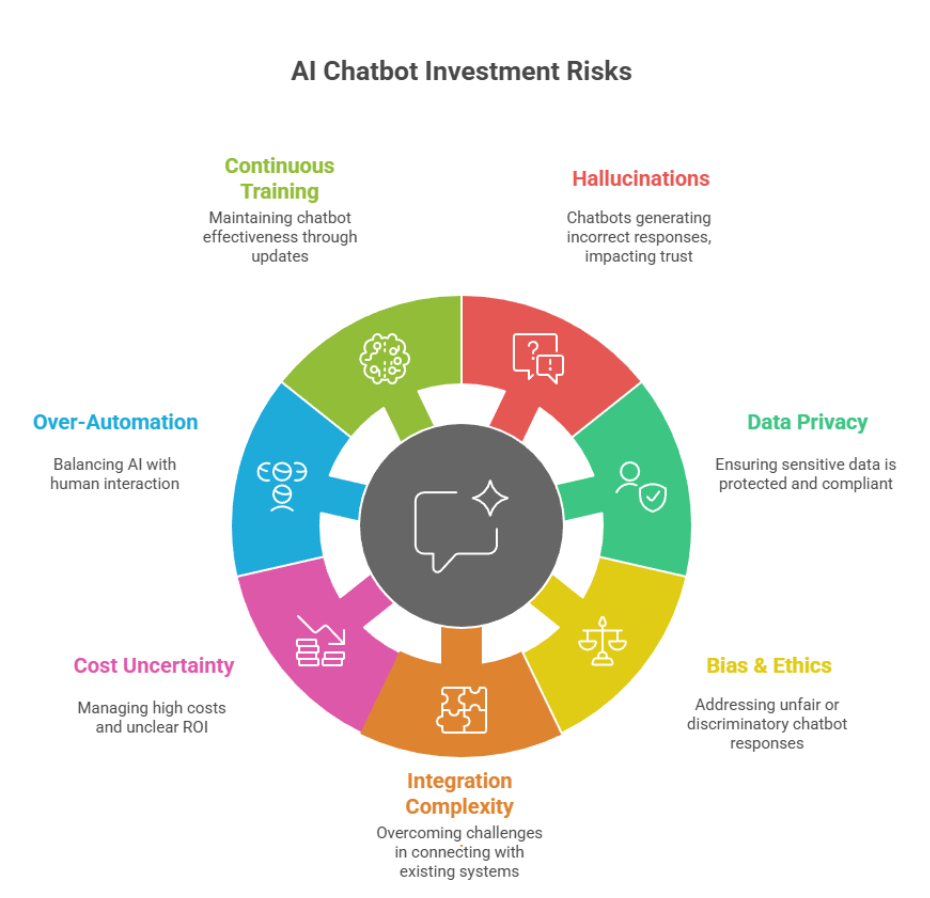
Challenges And Risks Companies Must Consider Before Investing In AI Chatbots
How Companies Prevent AI Chatbot Hallucinations In Customer Support?
One of the major risks associated with generative AI chatbots is hallucination, where the system produces confident but incorrect responses. To prevent this, modern organizations implement architectural guardrails instead of relying solely on model intelligence.
Retrieval-Augmented Generation (RAG) is widely used to ensure responses are generated strictly from verified internal sources such as knowledge bases, policy documents, and historical tickets.
Confidence thresholds, source validation, and automatic escalation to human agents further help maintain accuracy and trust in customer interactions, principles that are equally critical in local digital marketing, where relevance, reliability, and customer trust directly influence engagement and conversions.
AI Chatbot Implementation Roadmap For Enterprises
Successful AI chatbot deployment follows a phased approach rather than a single launch. The first phase involves pilot deployment, where chatbots are trained on limited use cases like FAQs or basic support queries.
This is followed by controlled scaling, where additional intents, channels, and system integrations are introduced. The final phase focuses on optimization refining response accuracy, reducing fallback rates, and enabling advanced features such as proactive engagement and personalization.
Challenges And Risks Companies Must Consider Before Investing In AI Chatbots
AI chatbot implementation comes with challenges such as data quality issues, integration complexity, security concerns, and over-automation risks. Without proper governance, chatbots can negatively impact CX by providing inconsistent or incorrect responses.
Organizations must balance automation with human oversight, invest in clean data pipelines, and continuously monitor chatbot performance to mitigate these risks effectively.
How To Choose The Best AI Chatbot For Your Company?
(i) Define The Objectives
The objective behind chatbot AI deployment is the first point to consider here. Now, it would change as per the requirements of the business. While some may need chatbot assistance to generate leads, others may need it to simply improve customer support.
Therefore, depending on your actual business objectives, you can choose how to curate it to achieve the best outcome.
(ii) Evaluate Data Integration And ‘Brain’ Quality
Today, a chatbot is as smart as the data it can access, and today the gold standard is Retrieval-Augmented Generation (RAG). It allows the AI to source facts directly from your private documents, old tickets, and databases instead of general training data.
As a result, the outcome becomes more precise and customized, which further improves customer experience.
(iii) Assess The Key Technical Features
The next point is assessing the key technical features. This includes considering pointers like multimodal capabilities, omnichannel presence, human-in-the-loop, and multilingual support.
A technically weak chatbot is destined to fail, irrespective of the money and resources you invest in it.
(iv) Check Security And Compliance
The next point to review is security and compliance. The chatbot you select must comply with GDPR, HIPAA, and SOC 2 standards. Additionally, you need to ensure that the company will not use the data to train public AI models. You can include this pointer in the service agreement for better security.
Now, instead of going through this hassle of evaluating different areas to find the best AI chatbot, you should simply contact us at Viacon Digital. Our team of experts will, based on your business needs, design, develop, and deploy a solution that perfectly fits your business and serves as the catalyst for its growth.
To summarize, the concept of a chatbot has moved from a tool that automates customer support to a strategic mechanism for driving business growth. Today, AI chatbots are a business asset offering an important competitive edge through improved customer interaction and better business outcomes.
However, adopting and deploying them is not about sourcing the right technology; it is about carefully evaluating all the aspects and making an informed decision that will support business operations going forward.
Therefore, businesses that invest strategically, i.e., understand the business objectives, choose the right framework, and trust the right partner for deployment, stand a chance to be the winner.
AI Chatbots For Startups vs Enterprises: Key Differences
Startups typically focus on rapid deployment, cost efficiency, and lead qualification, while enterprises prioritize deep system integration, compliance, scalability, and governance. Understanding this difference helps businesses avoid overengineering or underinvesting in chatbot capabilities.
Why Human-in-the-Loop Design Is Critical For CX Success
Even the most advanced AI chatbots perform best when combined with human oversight. Human-in-the-loop mechanisms ensure seamless escalation for complex queries and allow continuous improvement through conversation reviews and feedback loops.
This collaboration ensures CX quality while maintaining operational efficiency.
How To Continuously Optimize AI Chatbots After Deployment
AI chatbots require ongoing optimization to remain effective. Businesses must analyze conversation logs, identify intent gaps, retrain models with updated data, and refine workflows based on evolving customer behavior.
Organizations that treat chatbots as living CX systems consistently achieve higher engagement, accuracy, and satisfaction.
AI Chatbots For CX: Most Asked Questions Answered:
Q1. Are AI Chatbots Worth The Investment In 2026?
A: Yes, AI chatbots are worth the investment in 2026 as they reduce support costs, improve response times, and enhance personalization at scale.
Q2. Can AI Chatbots Fully Replace Human Customer Support Agents?
A: No. AI chatbots complement human agents rather than replace them.
Q3. How Long Does It Take To Deploy An AI Chatbot?
A: Most businesses can launch a pilot chatbot within a few weeks, followed by gradual scaling.
Q4. Are AI Chatbots Secure For Handling Sensitive Customer Data?
A: Yes, when deployed with proper compliance, encryption, and access controls